Just the thing to keep track of your friends, circa 1916.
M Y C O L L E C T I O N — During the Gilded Age of the late 19th century, "400" became synonymous with the country's wealthiest people. The
"Astor 400" referred to the number of guests invited to
Caroline Webster Schermerhorn Astor's lavish Manhattan parties, the number of guests that supposedly fit in her ballroom, the creme de la creme of New York's Social Register society members. The links above reveal the details of this society matron's life and parties designed to weed out the "riff-raff" of the millionaires, most likely the old money versus the new money...
Illustrated is my copy of the 1916 Summer Social Register, which I refer to often, rofl. This was a way to keep track of all of your wealthy friends, to help with sending invitations to your summer garden parties, or perhaps to facilitate meet-and-greets at any number of wealthy summer enclaves. The book begins with approximately 20 pink pages of updates received too late for the bulk of the book, titled Dilatory Domiciles—apparently "Updates" was considered declassé! Weddings, births, deaths, and newly-built summer mansions are included in this section.

The main interior pages begin with the key to the book's listings, top image, with little symbols representing the family's Sloop Yachts, Schooner Yachts, Steam Yachts and Launches, as well as specific places such as the Corinthian Yacht Club of Philadelphia and the Eastern Yacht Club of Boston, and whether the family was "abroad," or had "arrived." Specific summer home addresses are listed, as well as family members and contact information. Email addresses and phone numbers are oddly missing, as are ZIP codes, lol. I've noticed a typo/syntax error on the left page of the spread with the key. It ends with "To insure the finding of a name ..." and it should be "To ensure the finding..." So much for high-brow editorial education!
Interestingly, I've found the last names of two branches of my mother's family in this book, the Sanborns and Beatties, but they certainly weren't our immediate family. Many pages are dog-eared with entries circled in pencil, and the pages have obviously been leafed through quite a bit, but I really can't say why my family owned this book.
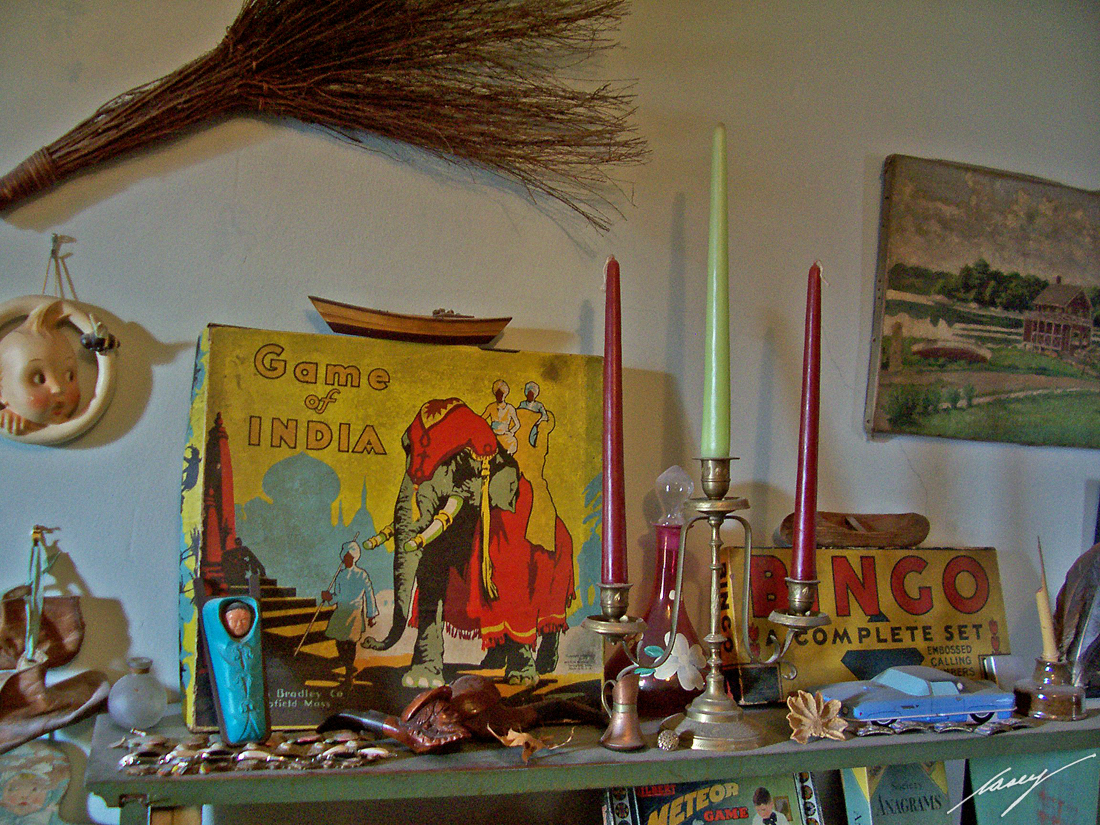
Oddly named letters game dates to 1934-35. "Society" had nothing to do with the game itself. Perhaps there are 400 separate letter pieces inside, but the name was clearly meant to evoke the "Astor 400," the highest of the high society of the day.
M Y C O L L E C T I O N — A table-game dated 1934-35 produced by the Einson-Freeman Publishing Corp. of New York City seemingly wished to be associated with this high-brow group. The box is filled with the cut-out cardboard letters which I spelled my name with, above. In short, the game seems to be a form of Scrabble without the points attached to each letter. Interestingly, there is absolutely no mention of "Society's 400" or any other sort of class distinction in creating words. In fact, at the end of the lengthy, and wordy (sorry!), instructions, it states: "All the usual letter, word, and sentence games referred to in magazines and books may be played with these letters." So it's really just a box of letters to be used as the player pleased, with a very cynical marketing attempt at being "classy."
B T W :
Game makers weren't the only ones that attempted to cash in on the cachet of High Society. Above, the 1952 Packard Patrician Four Hundred sedan. This illustration is from the Packard dealer brochure that year, found via Google Images at the Packard Info website. Even General Motors seems to have been trying to evoke an earlier, more classic time with their new-for 1962 Chevy II lineup. The base models were called 100, the mid-level trim was the 300, and the top-of-the-line versions the Nova 400. The convertible above was limited to the 400 series for the first year (Image found via Google Images). Do I know for a fact that the Nova 400 referred to the antiquated "Society 400?" No, but it's a good guess. I have no idea however why Chevrolet skipped the 200 nomenclature.
U P D A T E :
Monday, December 6th—I was just re-reading the December 1992 issue of Collectible Automobile, an article about the 1958-62 AMC Ambassador. I didn't remember from the first time I read it almost 20 years ago, that for 1962 only, the top-line Ambassador, above the Custom trim level, was the 400! Apparently, this "society" reference was really popular in the early 1960s. I wonder how many more 400s I'll come up with now that I've opened that door!
1962 was the year that the Ambassador shed nine inches from its wheelbase, dropping to 108 from 117. This meant that the Classics and Ambassadors were virtually identical except for taillight shape and trim levels. Maybe AMC felt that with this downsize, the Ambassador needed all the class it could get and gave it the 400 moniker.
The 400 name was dropped for the 1963 model year, when AMC fully redesigned their senior lines with VERY attractive new bodies, complete with curved sideglass and body sides stamped from one huge expanse of sheetmetal—something Lexus touted as a quality development in the 1990s. All trim levels were renamed with this redesign, changing to 880 for the base model and 990 for the Custom and 400 levels.