Today's the first day of spring, 2012. Yay! We've been having great spring weather for a few weeks, well, most of the winter actually, lol. I found this beautiful 1970 AMC Javelin last week being brought out of its winter hibernation. It's hard to believe this car is 42 years old now! This is as great an image of spring cleaning as any I've photographed...
Showing posts with label AMC. Show all posts
Tuesday, March 20, 2012
Wednesday, December 22, 2010
The First Small W-I-D-E Car: Bubble-icious!
The cover of AMC's 1975 catalog, featuring the first Pacer.
In 1975, AMC wowed the automotive world with its earth shattering, groundbreaking, Pacer. Billed as the first small, wide car, the Pacer measured a full 77 inches wide, 6 inches wider than the company's Hornet and Gremlin, and the equal of their full-sized Ambassador sedan. Another unique feature of the Pacer was the use of asymmetrical doors; the passenger's door was 4 inches wider than the driver's door for easier access to the back seat. Its wheelbase was 100 inches, the equal of its spiritual predecessor of sorts, the spunky 1950 Nash Rambler convertible, the car Lois Lane drove in the original Superman TV show (and who didn't love the young Jimmy Olsen in that series, played by Jack Larson, lol!).
Pacer's relatively short hood was a result of the planned use of GM's brand new rotary Wankel engine, a compact powerplant that was cancelled at the last minute by GM after the first gas "crisis" of 1973. Wankel rotary engines are powerful for their size, but thirsty, and after several years of development under license from Germany's NSU, their lack of economical gas usage and a failure to properly seal the rotors, GM called it quits. Mazda is the only manufacturer of Wankel rotary engines today, in their RX-8 sports coupe, and they're still considered thirsty for their size although the sealing problem has been overcome. AMC was stuck without a powerplant that fit under the short hood, and their inline-6 engines ended up with their last 2 cylinders practically sitting in the passenger compartment. For a longer write-up of the Pacer's development, I found this cool website.
Pages 3 and 4 of the brochure show the front and back of the wild new car, with interior shots as well. Both pages open up to a full four-page spread, below. On the left, in H8 Autumn Red, is the D/L model, and its optional "Basketry Print" fabric individually reclining bucket sets. Talk about distinctive! AMC really showcased unique interiors in their products, a tradition that went all the way back to the 1930s when Nash introduced their infamous "seats that fold into a bed." The H9 Silver Dawn base model Pacer on the right, shows the optional vinyl roof, separated by a body color "hoop" which was reminiscent of Nash's 1956 "Fashion Arch" styling, which allowed for a C pillar two-tone paint treatment also known as a "basket handle" to some. The Pacer's original bodystyle was eventually joined by a wagon version, which was just as wide and fishbowl-like as the hatchback, but which could be optioned with woodgrain sides—a plus in my book!
The four-page fold out showing the Pacer X model, and giving specifications and options. One quaint touch on such a futuristic new car was the option of good old-fashioned vent windows in the front doors. Oddly, under "power options" only power steering and power front disc brakes are listed. I would have thought power windows, door locks, and seat would have been available, and I think they were in later years.
BTW:
Motor Max's 1978 Pacer from their "Fresh Cherries" series. This scale model features the facelifted model with its rather ugly raised front hood and grille, necessary for the 304 V8 that was made optional later in the production run, but it's nearly invisible under the plastic case, lol. The rest of the scale model is pure, bubblacious and curvaceous, Pacer. The notes on the back of the package states that slightly over 280,000 Pacers were sold in the six years of production, a large volume for AMC.
Tuesday, December 21, 2010
The Sensible Spectaculars: '65 Rambler Lineup
This is a small AMC brochure featuring its full lineup for 1965, eight-pages, 10 1/2 x 6 1/2 inches. It was probably a car show piece, which frequently were smaller, cheaper and featured all of a makers car in one brochure. I've always liked the typography used in this piece, with the word "spectacular" printed in a full rainbow of colors—truly spectacular! The cover image shows the familial resemblance that Edmund Anderson brought to AMC that year, with all three lines featuring segmented horizontally-ribbed grilles and simple bumpers with amber turn signals located at the other edges.
The Ambassador for 1965 was redesigned and once again gained length and prestige with a 4-inch stretch in wheelbase to 116". This compared with the 108" of 1962 and 112" of the 1963-'64 models, but still an inch short of the 117" span of the '58-'61 models. Vertical headlamps, first seen on the '57 Nash, and later on the '63 Pontiacs, gave the Ambassador an upscale appearance. It's too bad that bodystyles didn't include a 4 door pillarless hardtop, as Nash offered them as far back as '56 for sedans and even wagons. Technical features included "Double-Safety" brakes with optional front Disc Brakes, V8s and a new inline 6, adjustable steering wheels, reclining bucket seats and new "miracle" fabrics. I love that sliver of woodgrain on the wagon, and that dark blue sedan is elegant!
The '65 Classics featured a 112" wheelbase, and sported new and larger-looking facelifted bodies. Bodystyles included a 4 door sedan, 2 door pillarless hardtop, convertible and wagons. Engine choices included a Six and several V8s, and the wagon could be had with 2 different tailgates, one that folded down and one that swung out. For '66 Ford offered its first "Magic Tailgate" that could do both, but AMC gave you one or the other.
Ah, the Rambler American, the direct descendant of the first 1950 Rambler. Offered only with sixes this year, the American had features such as curved side glass, a standout feature in the low-price class. Available in a full spectrum of bodystyles and trim levels from basic sedans to sporty and luxurious hardtops and convertibles, a Twin-Stick transmission was also available, which included a separate overdrive lever. Those red vinyl reclining bucket seats are glorious, aren't they?
Update:
Both the Classic and Ambassador were available as 2-door sedans as well, for both '65 and '66, in various trim levels. They weren't included in this brochure, but as they weren't considered "sexy" I can see why they left them out of this very small car show edition. Thanks to loyal, and erudite, reader, Paul for this clarification! See the comments section for the details. I think this is the best part of my blog—the dissemination of information from "both sides" of the keyboard! Thank you.
Coming Up Very Soon by Popular Demand:
I've just found my 1975 AMC brochure featuring the first wide small car, the fishbowl on wheels, the Pacer. Scanning as I type this!
Sunday, December 19, 2010
AMC's Designer Hornet Sportabout
The back of this one-page folder shows, at age 15, I was quite intent on pricing out this little gem. I'm sure I was using the Consumer Guides' pricing book, which was available at any magazine stand.
M Y C O L L E C T I O N — The 1970s fascination with designer labels had a very unlikely participant in the 1972 AMC Hornet Sportabout wagon. Gucci, one of the premier Italian design houses, designed a "special" all-vinyl interior in his then-trademark colors of green, red and cream. The headliner featured his interlocking GGs logo, and there appears to be some sort of ceiling tray illustrated as well. The 1970s were not the best for Gucci, almost going into bankruptcy by decade's end, and I can't help but think that creating a multicolored interior for an American economy car, wasn't one of their savviest decisions. According to Wikipedia, slightly more than 2500 Gucci-equipped Sportabouts were sold in 1972, with an additional 2200 in '73, so it wasn't a sales flop by any means. Italian luxury could have been yours for just a few dollars shy of $150 in 1972 currency.
• For a well-written blogpost about the 1970s designer edition cars, including the Gucci Sportabout, click over to Palm Springs Automobilist from July 26, a fellow blogger that has commented here before. In fact, I just added his site to my Blog Roll on the right side of this blog.
• Halston, Gucci, Fiorucci!—The music industry wasn't immune to the charms of the designer label either. Here is a link to Sister Sledge's He's the Greatest Dancer, which drops designer names like loose sequins on a dance floor, lol. Of course, the Sisters best known hit disco song was We Are Family...
Friday, December 10, 2010
"The New American Car," 1970
Cover and back cover of the introductory brochure for AMC's new-for-1970 subcompact offering, the Gremlin. The booklet is 7 3/4 x 11 inches with a total of 8 pages (I didn't scan the last spread). The entire brochure is cleverly art directed in red, white and blue, emphasizing the American-ness of this newest, and most radical-looking domestic subcompact, basically a cut-down Hornet, also new for 1970.
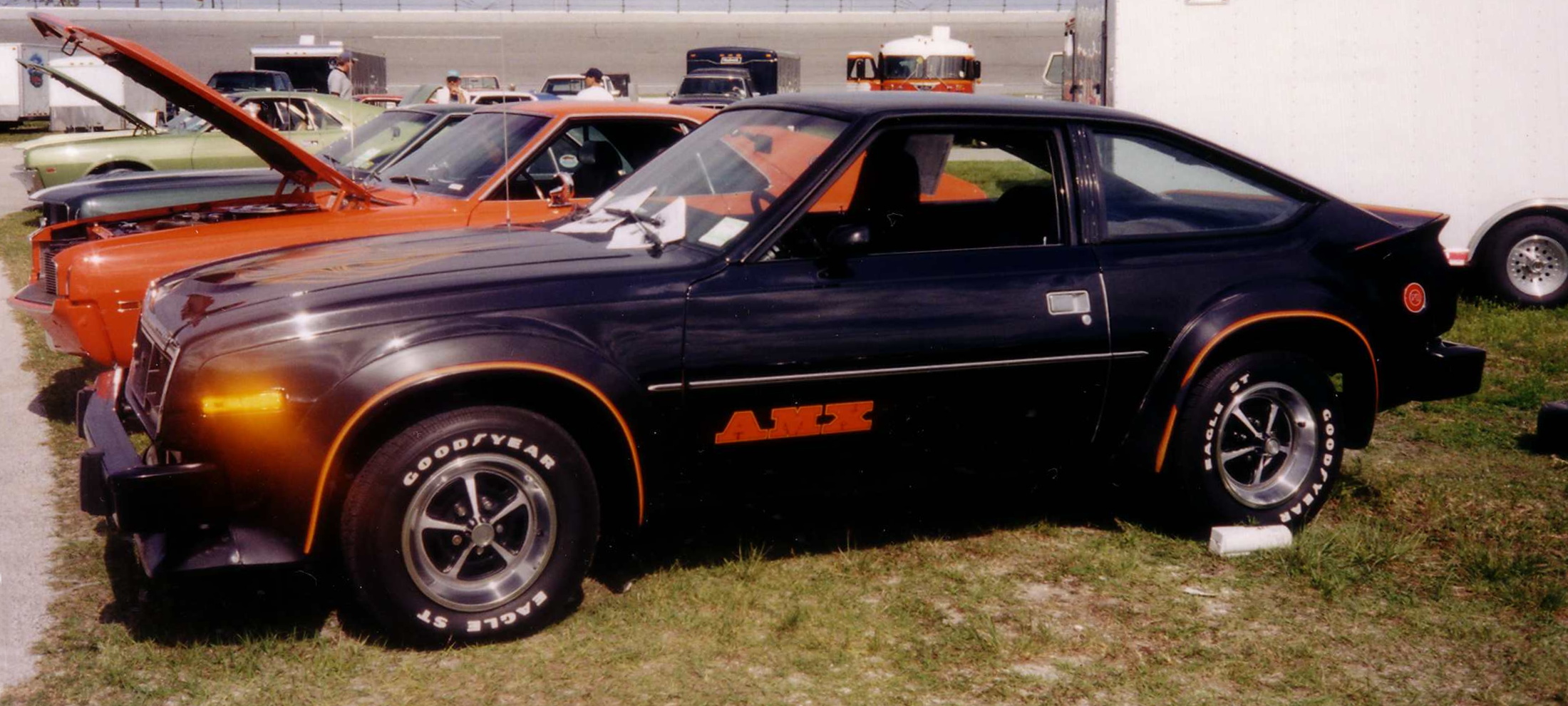
Spunky and fresh, with a profile unlike any domestic car produced at the time. Gremlin's ads often compared the car with VW's Beetle. The Gremlin eventually morphed into the AMC Spirit and lasted in facelifted form right through 1983. With a second bodystyle added, a really good looking fastback, the Spirit was even marketed as an AMX. As an Eagle Kammback and SX/4, it was available with All-Wheel Drive.
Available in both 4-seat and 2-seat versions, the 4-seater came with a lift-up rear glass hatch, while the basic 2-seater came with a fixed rear glass, meaning luggage had to be loaded through the side doors. Originally available only with 6-cylinder engines, 199 cubic inch standard with a 232 optional, the little car eventually offered a V8 in subsequent years, as well as sportier looking "X" packages.
Friday, December 3, 2010
A Few More Pieces and I'll Have a Car
This very stylized logo used on the 1966 Ford Country Squire station wagon could only have been designed in the Sixties. Close to 3 1/2 inches in diameter, I would have been very happy to have the assignment to work on details like this, had I pursued a career in car design. Isn't the horse's head beautifully rendered? For a Google Image photo of the '66 Country Squire and the logo placement on the front fender, click here.
I'm guessing this 5-inch Nash hubcap dates to the early 1920s. Nash Motors began producing cars in 1916. This small cap, which literally covered only the center hub of the large wheels of that period, is cast from brass and was plated, probably in nickel. There is a tear in the brass—I can only imagine the force needed to do that—a car accident, perhaps? I found this in my dad's garage bins when the house was sold, He was as much of a pack rat as I am. I love the dull sheen and the slight glow of the aged brass coming through the thinning nickel outer plating, sort of like the way I fade layers in my art. The oh-so Twenties logo and typography is charming as well.
The gas cap used on the early 1970s AMC Hornet. American Motors created some great logos for their cars in the '60s and '70s, including the Marlin, Gremlin and this Hornet, They were whimsical, stylish and well-detailed, and small items like this gas cap were well-made of quality materials.
I once had close to 100 hubcaps/wheelcovers in my collection, but they're one of the few things I downsized at my last move, and it was very difficult for me to let them go! I now have only ten or so. I'll photograph and post them one of these days.
Friday, November 12, 2010
$3.99 Car of the Week: 1974 Gremlin
I actually bought this Gremlin several years ago, but with my recent AMC post on its '74 lineup, I realized this little Matchbox-sized Gremlin should have been posted also. This is a series called "Fresh Cherries" by MotorMax and has great detail for such an inexpensive collector piece. I find it interesting that they chose the '74 Gremlin, which isn't the most attractive version. I would have gone with either the original '70 or the '77 which had a shortened and more attractive facelift, but for "oddity" value, this '74 is right up there. I also bought a '70 Maverick Grabber and a '71 Pinto Runabout at the same time, and they all came in factory colors, always a nice touch.
Wednesday, November 3, 2010
A Look Back at AMC: 1974's Pivotal Year
From AMC's 1974 Full Lineup Dealer Brochure
Front and rear covers of AMC's full lineup dealer brochure from 1974. The front features the brand new-for-'74 Matador Coupe, with the Hornet Hatchback to the right and the Gremlin to the left. All appear to be decked out in X trim, the sportiest version of each model. The back cover features the luxury Ambassador Brougham sedan in the center with a Javelin to its right and a Hornet Sportabout wagon to its left. This last Ambassador, with a 122" wheelbase, is the largest this platform would become. The Ambassador and the Javelin would both be gone by 1975.
• I can't really look at AMCs of this vintage without thinking of the James Bond movie, The Man with the Golden Gun, which used several 1974 AMC cars in its production. Bond commandeered a Hornet Hatchback coupe, and the evil Scaramanga's Matador Coupe sprouted wings and flew away.
• Further information at Wiki for Ambassador, Matador, Javelin, Hornet, and Gremlin. The cult-classic Pacer would be introduced the following year, 1975.
Four selected detail shots from the chapter openers in this brochure, Gremlin, Hornet hatchback, Hornet Sportabout and Matador coupe. Notice the white lettered performance tires on three of the cars, including the Sportabout with the woody option. Also notice the copper-toned grille inserts for the Matador coupe. They were included with the top-of-the-line Oleg Cassini edition, which also had a unique luxury interior and specific exterior colors and trim.
The Gremlin's optional interior treatments included this red "Fairway" simulated knitted vinyl bench/buckets, and the now-famous LEVI'S faux-denim bucket seats.
The Oleg Cassini edition Matador coupe interior. with copper-colored accents, including an Oleg Cassini crest on each seat back, with rich black everywhere else. This button-tufted cloth split bench seat traces its roots back to Nash's infamous reclining seats of thirty years earlier.
The AMX was now a trim level of the Javelin series, in this the Javelin's final year on the market. The original 2 seat AMXs, 1968-70, are highly-collectible now. I was never as enamored with the facelifted body of the '71-'74 Javelin/AMX. Standard engine for the Javelin was the trusty 232 I-6, and for the AMX, the base 304 V8. Optional powerplants included the 401 V8 with "Go" Package.
This color chart is so definitely NOT from this century, lol. Check out the SEVEN vinyl roof color options. The main palette is full and very saturated with pigments in every hue. I think it sure beats the heck out of the various silvers, grays and blacks we're given as choices today!
Monday, August 30, 2010
1 Part Useless SUV+1 Part Defunct Auto Brand =
Odd, front-wheel drive base model Jeep Compass, greets its second-cousin, once removed, ancestor, the long-defunct Eagle brand, and the result is this little hipster pickup with precious little cargo room and even less off-road traction, the Jeep Eagle Compass Cute/Ute Pickup Thingy. But it's damn attractive!
C H O P — Sometimes the mouse clicks and drags wherever the mouse wants to click and drag. I started with a photo of the 2007 Jeep Compass, a Jeep in name only. Its platform is more closely related to a Dodge Neon than it is to any "Trail-rated" puddle- and tree-jumper Jeep. The fwd Compass MAY have drawn an additional 12 people into Jeep showrooms, but no one took names so I don't believe it.
Photoshop allows me to create cute little vehicles, without any consideration of platform capability or production numbers or any practical considerations at all. The long-gone Eagle brand was created by the equally long-gone automobile manufacturer, American Motors Company. Eagle actually soldiered on for a couple of years after AMC ceased to exist, having been absorbed into the Chrysler company, but was never more than a Hornet or Gremlin in tippy-toe all-wheel drive drag. The Compass, and its more sanely-styled Patriot brother, are really more akin to an Eagle than a Jeep, so I thought it would behoove Chrysler to rebrand the cars as Eagles. What says 'buy me now' more than a small pickup truck with a three-foot bed, front-wheel drive, macho side cladding, suicide doors, and a cute smiling face? And the slotted roofrack is PERFECT for that off-roading necessity, a new Tempur-Pedic mattress from Bed, Bath & Beyond!
I started this chop a few years ago, when the Compass was first introduced. Checking out Woody's Car Site last night, I saw he posted a piece on the updated Compass coming out shortly. When I saw the press photo of the original Compass there, the same original I used for this chop, I was reminded of my little pickup chop. I opened up the file from the archives, and spent a couple of hours updating it and "fixing" several errors in the original chop, making it even cuter than it was, lol. So thank you for jogging my memory, Woody! Check out Woody's post here.
Friday, February 19, 2010
Late '60s AMC Wasp prototype
C H O P — This image shows what could have been a late '60s prototype midsize sedan from AMC, the Wasp. It would have been developed concurrently with what eventually became the Hornet. This approach, using much of the upcoming Javelin's design cues, could have been one of the first 4 door 'coupes. . .' Photo shows it to be a bit down-at-the-heels today, but still svelte!
History artandcolour style, bien sur.
Subscribe to:
Comments (Atom)